

Quick Answer: Start with your credit card statement date, payment due date and minimum amount due. Check purchases, payments and finance charges separately. Make sure at least the minimum payment reaches your bank by the due date; interest may still apply when you carry a balance. Query unfamiliar entries promptly through your bank’s official channels.
Meet Sara. She lives in Dubai and uses her credit card for everyday spending. On 1 January, she spent AED 2,000 on it. On the due date, 31 January, she paid AED 100.
Now it is 6 February. Sara opens her new statement, and something looks odd. Her balance only went down by AED 28.55.
The difference is a finance charge: interest added to the account. To understand why her payment made such a small dent in the balance, Sara needs to check the statement dates and the interest entry.
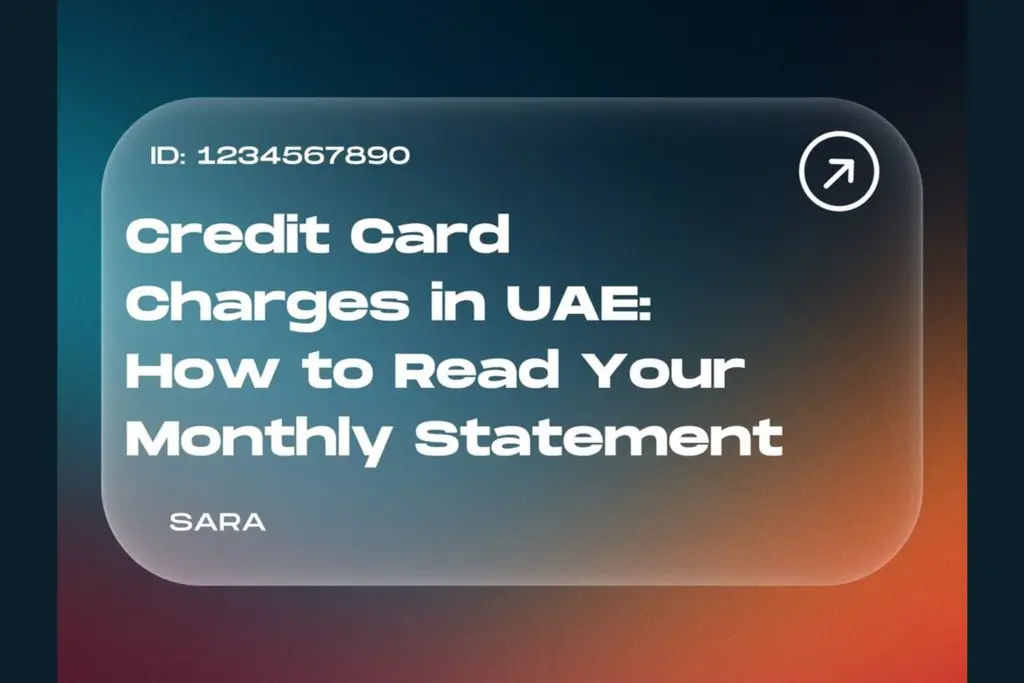
Your monthly credit card statement shows what you owe, the minimum payment required and when it is due. Here is how to read those figures, check common charges and query an entry that looks wrong.
Sara is a fictional cardholder used for this educational example. Her story does not describe an actual customer’s experience; your own card’s rates and terms may differ.
What to check first
Your statement is a snapshot of your card up to the statement date.
Make sure at least the minimum amount due reaches your bank by the due date to avoid a late payment fee.
Interest and fees appear as separate lines. Look for them.
If something looks wrong, check the dates first. Then contact your bank.
Start with the main numbers
Start with the statement date, payment due date and amounts due. Every bank lays out its statement a little differently, but most show these items:
| Item | What it means |
|---|---|
| Statement date | The day your billing period closes. Anything after this date goes on your next statement. |
| Payment due date | The date by which the bank must receive at least the minimum amount due to avoid a late payment fee. |
| Total amount due | Everything you owe as of the statement date. |
| Minimum amount due | The smallest required payment for that statement. Paying this amount on time can avoid a late payment fee, but interest may still apply. |
| Credit limit | The most you can spend on the card. |
| Available limit | How much of your limit is still free to use. |
| Finance charge | Interest charged under your card’s terms, such as when you carry an unpaid purchase balance or take a cash advance. |
The names may differ slightly from bank to bank. Islamic cards may use words like “profit” instead of “interest”. If you are unsure about a term, ask your bank.
Where did the extra AED 71.45 come from?
The following timeline uses the published calculation cited in the source note below:
| Date | What happens |
|---|---|
| 1 January | You spend AED 2,000 on the card. |
| 6 January | Your statement is issued. It shows AED 2,000. |
| 31 January | This is the due date. You pay AED 100. |
| 6 February | Your next statement shows AED 71.45 in interest. The bank labels this illustration with an annualised percentage rate (APR) of 44.28%. |
Then she does the maths:
She paid AED 100, but the next statement added AED 71.45 in interest, leaving her balance only AED 28.55 lower. This is the bank’s specific illustration, rather than a calculation to apply to every UAE card. Check your own card’s Key Facts Statement for its interest rate and calculation method.
Check the other charges
Review the fee entries as well as the purchases. These are common items to look for:
| Charge | What it is | What to check |
|---|---|---|
| Finance charge | The cost of carrying an unpaid balance. | Does it match the rate in your card agreement? |
| Annual fee | A yearly fee for having the card. | Was it waived under your card’s offer? |
| Late payment fee | A fee that may apply if the bank does not receive the required minimum payment by the due date. | Compare your payment date with the due date. |
| Cash advance fee | A fee for withdrawing cash with your card. | Cash advances often cost more than normal spending. |
| Foreign currency fee | A fee when you spend in another currency. | Check the exchange rate and the fee. |
| Instalment plan | A purchase split into monthly payments. | Check the monthly amount and any plan fee. |
Some fees may show VAT as a separate line.
Why your app and statement balances can differ
Your statement records the account at the close of a billing period. Your banking app may show later payments and purchases, as well as pending transactions. Check which balance the app is displaying before comparing the two.
When the two numbers do not match, compare the statement date with the dates of the recent entries in your app. The difference is usually explained by timing.
If a payment or refund is missing
If you cannot find a payment or expected refund, start with the transaction date and reference number:
Keep your proof. Save the transfer receipt or reference number.
Check the dates. Was the payment made before or after the statement date?
Contact your bank. Share your proof and ask them to trace it.
Be careful with refunds. A refund can take time to show up. Do not assume it has already reduced the amount you owe.
While you wait, ask your bank how much you should pay and by when, so you do not miss the due date.
What paying only the minimum means
Paying at least the minimum amount due on time can avoid a late payment fee. It still leaves a balance to repay, and interest may apply. To qualify for an interest-free period on purchases, you generally need to pay the full amount specified in your card terms by the due date. Carrying a balance can also affect the interest-free period on new purchases. Check the conditions for your card. For practical repayment steps, read our guide to paying down credit card debt.
If you do not recognise a charge
If a transaction looks unfamiliar, check it promptly:
Step 1: Check the basics. Compare the charge with your receipts. A shop’s name on the statement is sometimes different from the name you know. Also look for the same purchase listed twice.
Step 2: If it still is not yours, act fast. It may be fraud. Block your card in your banking app or call your bank’s official number (on the back of your card or in the app). Report it as soon as you can.
Step 3: Send a clear message. For a charge you want explained, you can write something like this:
“Hello, I would like to query a charge on my credit card statement dated [date]. The charge is AED [amount] from [merchant] on [date]. I do not recognise it / I believe it is wrong. Please explain it or investigate it. Please also confirm what I should pay by the due date while this is checked.”
Remember: asking a question does not stop your payment due date. Always ask the bank what you should pay in the meantime.
A monthly statement checklist
Use this checklist when each statement arrives:
Note your statement date and due date.
Check every purchase against your receipts.
Look for interest, fees and VAT lines.
Confirm your last payment is shown.
Arrange payment early enough to reach the bank by the due date. Pay the full statement amount where possible; if you cannot, pay at least the minimum and work out what more you can afford.
When your balance keeps growing
If your balance keeps growing despite regular payments, review your interest charges, new spending and the amount you repay each month. Read our guide to debt management plans to understand how a plan works, or explore Lotus Debt Management’s Debt Management service for help reviewing your repayment options.
This article is general information from Lotus Debt Management, not financial advice. Sara is an imaginary example. Always check your own card’s terms and conditions with your bank.
Sara is fictional. The calculation is adapted from the following published source and does not describe an actual customer’s experience. No bank endorsement is implied. Source: Emirates NBD Credit Cards Key Facts Statement