


Quick Answer:
If your debt burden ratio is above 50% in the UAE, ask the bank to explain the figures before you try another application. Check your card limits as well as your loan payments. And if you’re struggling with payments you already have, speak to your current bank about reviewing them.
“But I haven’t missed an EMI.”
You might be thinking exactly that after a loan rejection. Your salary comes in, the bank takes its instalment, and you’ve managed to pay the cards too. So the rejection feels difficult to understand.
The first thing to ask for is the calculation. Which income did the bank accept? Which debts did it include? Was it assessing your current payments, or those payments plus the loan you wanted?
Until you know those answers, you could spend time changing something that wasn’t causing the problem.
What Does DBR Actually Tell You?
Debt Burden Ratio is the share of your gross monthly income committed to assessed debt repayments. If you’ve been comparing your repayments with the salary credited to your account, check whether that income figure matches the lender’s.
Take AED 18,000 of gross monthly income and AED 9,000 of commitments. The result is 50%.
Under the CBUAE’s general individual lending rules, instalments across relevant loans and facilities should not exceed 50% of gross salary and regular income. Specific exceptions can apply. Certain guaranteed housing programmes for UAE nationals, for example, have different provisions in the mortgage regulations.
Your bank needs to confirm the requirements for your particular borrowing.
There is also your own budget to think about. Half your salary may sound like plenty to live on, until you take out rent, school fees, transport and groceries. Work out what you actually have left. Being below a lending limit doesn’t mean the next EMI will be comfortable.
Check the Credit Cards, Even the Ones You Hardly Use
Pull out your card statements and look at two numbers: the balance and the limit.
You may owe very little. But a card with a small balance can still have a large limit, and that available borrowing can affect the bank’s assessment.
The Lotus DBR Calculator uses 5% of total active card limits for its estimated monthly card commitment. With combined limits of AED 40,000, it adds AED 2,000.
Don’t confuse that with the minimum payment on your statement. Your statement tells you what the card issuer expects you to pay. The DBR estimate is being used to assess affordability. Ask the lender how it treats your cards.
Have a card you haven’t used in months? Ask about reducing the limit. If you’re considering closing it, check the balance, any instalment plan and recurring payments first. Then keep the written confirmation and ask when the lending assessment can reflect the change.
Reducing a limit doesn’t pay off what you owe. It only changes the amount available to borrow.
How the Numbers Can Take You Above 50%
Here’s an illustrative example using AED 18,000 of monthly income. These aren’t figures from a Lotus client account.
| Commitment | Monthly amount |
|---|---|
| Personal-loan EMI | AED 6,200 |
| Car-loan EMI | AED 1,400 |
| 5% of AED 40,000 in card limits | AED 2,000 |
| Total | AED 9,600 |
AED 9,600 ÷ AED 18,000 × 100 = 53.3%.
You might have counted just the two loan EMIs, which come to AED 7,600. Adding the card estimate puts the total at AED 9,600. No new loan has been added yet.
Now suppose the combined card limits were reduced to AED 20,000. Keeping everything else the same, the estimate would use AED 1,000 for cards. Total commitments would be AED 8,600 and DBR about 47.8%.
That is a different result on paper. You still have the same loan payments, though, and any outstanding card balances still need paying. A bank also has other criteria to consider before approving finance.
What if the Bank’s Figure Still Looks Wrong?
Compare it with your documents. Has a settled loan been included? Have you counted additional income that the bank hasn’t accepted? Does the assessment include a proposed EMI you left out?
Ask about each difference rather than arguing over the final percentage. If a loan has been settled, have the settlement confirmation ready. If you’ve reduced a card limit, keep that confirmation too.
For a mortgage, there is another possible difference. The bank assesses payments at a higher interest rate to check affordability if rates rise. You can read the CBUAE’s mortgage stress-testing requirements. The payment used for that check may be higher than the EMI you’ve been quoted.
When the EMI Itself Is the Problem
Perhaps your income has fallen, or a new essential expense has left you short. In that situation, another application won’t address the payment that’s due next month.
Contact the current lender and explain what’s changed. Be specific. “My salary has fallen from AED 18,000 to AED 14,000” gives the bank something to assess.
Ask who handles repayment reviews and which documents they need. Gather recent income evidence, loan and card statements, and a list of essential monthly expenses. If you’ve already missed a payment, include that in the conversation.
The CBUAE’s restructuring standards recognise changes to repayment terms and schedules. What your bank can offer will depend on its assessment of your account and circumstances.
Don’t assume a request changes your due date. Your existing payment agreement applies until the lender confirms otherwise.
A Lower EMI: What Else Changes?
A smaller monthly payment can make a real difference to your budget. But read the repayment schedule before agreeing.
When would you finish paying? What rate applies? Are there fees? How much would you repay over the whole term?
Ask for the full offer in writing. A longer term can lower the EMI and increase the total amount repaid. Ask how the arrangement will be reported to the credit bureau, too.
Look at missed-payment terms as well. You want to understand the arrangement while you have time to compare it.
Where Does Consolidation Fit?
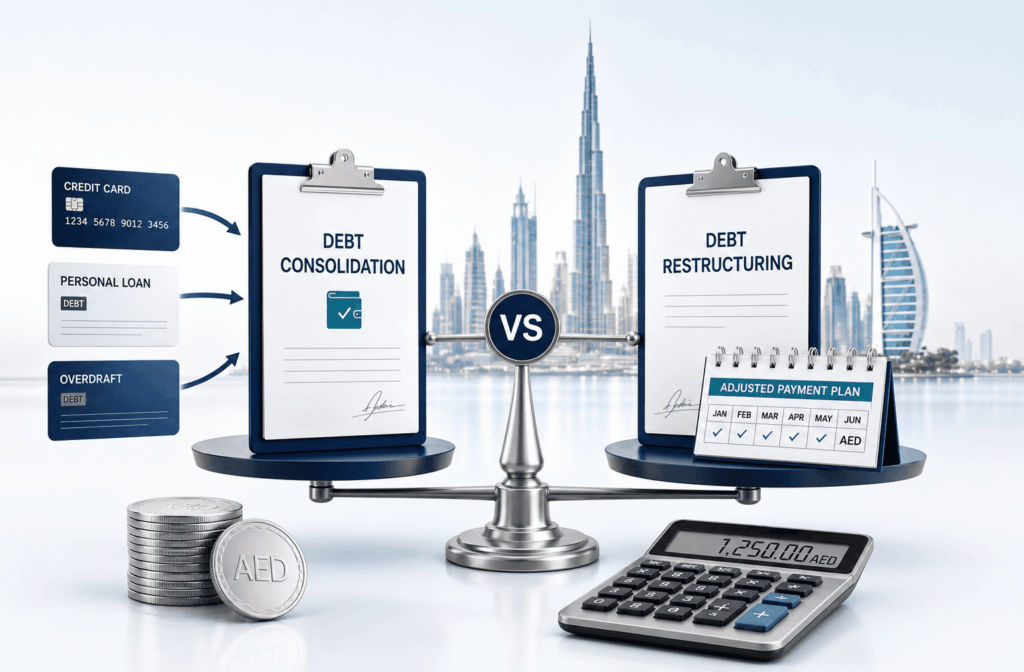
Consolidation usually means using a new facility to settle existing debts. Restructuring changes the terms of existing debt. Check which option is actually being discussed.
If you’ve received a consolidation proposal, find out which accounts it would settle, what happens to the cards and what fees are included. Compare the total repayment with your current position.
With a high DBR, new borrowing may be difficult to obtain. Ask your existing lender about its repayment options before spending time on another application. Lotus also provides debt management and restructuring support.
Give Yourself Time to Understand the Rejection
It can be tempting to try several banks or use a card cash advance to get through the month. First check what caused the rejection. The same commitments will still be there on the next application, and a cash advance adds borrowing costs to an already stretched budget.
Keep answering your lender and save the correspondence. Be cautious about anyone promising guaranteed approval or a debt write-off.
Talk to Lotus About Your Repayments
You don’t need to have all the answers before asking for help. Start with your latest statements and income details. The Lotus DBR Calculator can help you put the figures together.
If you owe several UAE banks or need help understanding a repayment offer, contact Lotus Debt Management for a confidential discussion. The team can help you review your liabilities and explore repayment options. Any revised arrangement needs the relevant lender’s assessment and agreement.
Frequently Asked Questions
Does a DBR above 50% mean I’ve defaulted?
No. You can be making every payment on time and still have a high DBR. The ratio concerns assessed debt against income; default concerns your repayment obligations.
Can I get a loan if my DBR is above 50%?
It may be difficult under the general lending limit. Ask the bank to explain the requirements for your application. Exceptions have specific conditions and don’t guarantee approval.
Does rent count?
Rent is generally a living expense. A loan or card repayment used to finance rent is a debt commitment. Mortgage lenders also consider household expenses when assessing what you can afford.
Will closing a credit card help?
Possibly, if active limits affect your lender’s calculation. Check the balance and closure requirements, then ask when the bank can reassess your position.
Can restructuring reduce my EMI?
It can if the bank agrees to suitable revised terms. Check how long you’ll pay and the total cost, as well as the new EMI.
Can Lotus help with several banks?
Lotus offers debt management and restructuring support involving multiple UAE lenders. Bring the details for each account so the team can discuss the assistance available.