
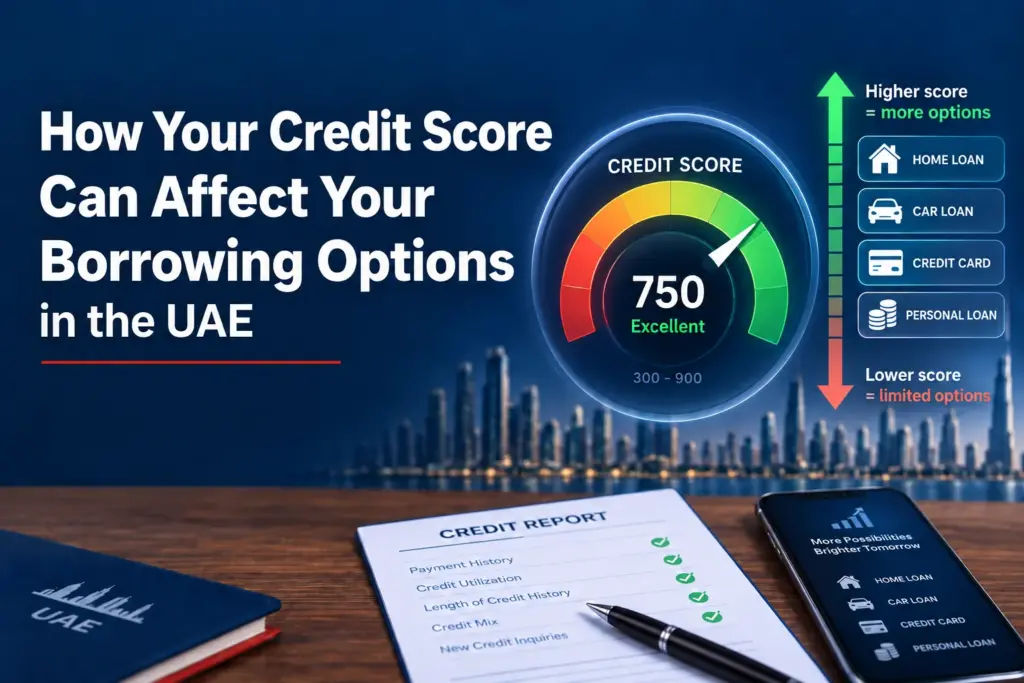
💡 Quick Answer: Your AECB credit score gives UAE banks a quick indication of how you have managed borrowing in the past. Scores range from 300 to 900, and a higher score generally reflects a stronger credit profile. But the score is only part of the picture. Banks also look at your salary, existing loans, credit card balances, repayment history, employer profile and Debt Burden Ratio (DBR). A strong score can support an application, but it does not guarantee approval.A good salary does not always mean a bank will approve your next loan. We regularly see borrowers focus almost entirely on income. Someone may earn AED 20,000 or AED 30,000 a month and still be surprised by a rejection. The reason is simple: lenders are not looking at salary in isolation. They are also looking at how much you already owe, how much of your monthly income is committed to repayments, how your credit cards are being used and whether past payments have been made on time.
Your AECB credit report and credit score help lenders see that broader financial picture.
If you are thinking about applying for a personal loan, credit card, car finance or mortgage in the UAE, it is worth understanding what a lender is likely to see before you submit the application. Sometimes the issue is not the score itself. It may be an old balance, a high DBR, several active cards or simply too much existing debt compared with income.AECB Credit Score and UAE Borrowing: Key Numbers
| Data Point | Figure | What It Means |
|---|---|---|
| AECB credit score range | 300–900 | Higher scores generally indicate a stronger credit profile. |
| Maximum DBR | 50% | Total monthly repayments across relevant credit facilities are generally limited to 50% of gross salary and regular income. |
| Personal loan regulatory ceiling | Up to 20× income | This is a regulatory maximum, not a guaranteed borrowing amount. |
| Maximum personal loan tenure | 48 months | Personal consumer loans are generally structured within a maximum four-year repayment period. |
| Universal minimum AECB score | None | Banks apply their own lending, affordability and risk policies. |
These figures describe general UAE regulatory limits and credit-score information. They should not be read as guaranteed bank approval criteria.
What Is an AECB Credit Score?
The Al Etihad Credit Bureau (AECB) receives credit information from banks and other participating organisations in the UAE. Your credit report brings together details about your borrowing history and current facilities. Your credit score then gives lenders a simplified indication of your overall credit risk. Official information is available through Al Etihad Credit Bureau. AECB scores range from 300 to 900. A higher score generally points to a stronger credit profile, but it should not be treated like an exam where one number automatically means “approved” and another means “rejected”. Banks make their own decisions. For example, a borrower with a relatively strong score may still struggle to get new finance if most of their salary is already committed to existing repayments.What can affect your credit profile?
- Repayment history: whether loans and credit cards have been paid on time.
- Outstanding debt: how much you currently owe across different facilities.
- Credit card usage: repeatedly carrying large balances can suggest financial pressure.
- Recent applications: several applications within a short period may become relevant during underwriting.
- Existing facilities: lenders look at your overall liability position rather than one account in isolation.
Is There a Minimum AECB Score for a UAE Loan?
No single AECB score works as a universal approval threshold across every UAE bank. You may come across figures such as 600, 650 or 700 online. Those numbers may reflect the lending practices of a particular bank or the experience of individual borrowers, but they should not be treated as a UAE-wide rule. A lender may consider several things at the same time:- monthly salary and regular income;
- employer profile and length of service;
- existing personal loans and auto finance;
- credit card balances and limits;
- monthly repayment commitments;
- recent payment behaviour;
- Debt Burden Ratio;
- amount of new finance requested; and
- the bank’s own internal credit policy.
What the 50% DBR Rule Looks Like in Practice
Before applying for more credit, one of the most useful numbers to understand is your Debt Burden Ratio. Under current UAE Central Bank rules, repayments across relevant credit facilities generally should not exceed 50% of gross salary and regular income.| Monthly Income | 50% DBR Ceiling | Example Existing Repayments | Illustrative Headroom |
|---|---|---|---|
| AED 10,000 | AED 5,000 | AED 3,000 | AED 2,000 |
| AED 15,000 | AED 7,500 | AED 5,500 | AED 2,000 |
| AED 20,000 | AED 10,000 | AED 6,000 | AED 4,000 |
| AED 30,000 | AED 15,000 | AED 11,000 | AED 4,000 |
How Much Can Someone Borrow Based on Salary?
UAE Central Bank regulations provide a personal consumer loan ceiling of up to 20 times salary or total regular income. The maximum repayment period for a personal consumer loan is generally 48 months. That sounds straightforward on paper, but the 20× figure is only a ceiling. It does not mean that someone earning AED 20,000 will automatically qualify for AED 400,000.| Monthly Salary | 20× Salary | 50% Monthly DBR Ceiling |
|---|---|---|
| AED 10,000 | AED 200,000 | AED 5,000 |
| AED 15,000 | AED 300,000 | AED 7,500 |
| AED 20,000 | AED 400,000 | AED 10,000 |
| AED 25,000 | AED 500,000 | AED 12,500 |
| AED 40,000 | AED 800,000 | AED 20,000 |
How Your Credit Profile Can Affect Borrowing
1. Loan approval
A lender wants to know whether you are likely to make the next payment on time. A consistent repayment record can help build confidence. Recent missed instalments, overdue accounts or signs of financial stress can have the opposite effect. There is still no single AECB score at which every bank automatically says yes or no.2. Interest rates and borrowing costs
Banks price finance partly according to risk. Someone with a stronger overall profile may sometimes be offered better terms than an applicant who appears more difficult to lend to. But the credit score is not the only factor. Salary, employer category, loan amount, product type and the bank’s current pricing policies can all affect the final offer.3. Credit card limits
Meeting the salary requirement for a particular card does not mean the bank will automatically offer the maximum advertised limit. If you already have several cards, large limits or substantial outstanding balances elsewhere, the lender may take a more conservative view.4. Maximum borrowing capacity
This is where credit history and affordability meet. A bank is not only asking whether you have repaid well in the past. It also wants to know whether your current income can comfortably support another monthly payment. That is why someone with a respectable score can still find it difficult to borrow more when existing repayments already consume a large part of their salary.5. Debt consolidation
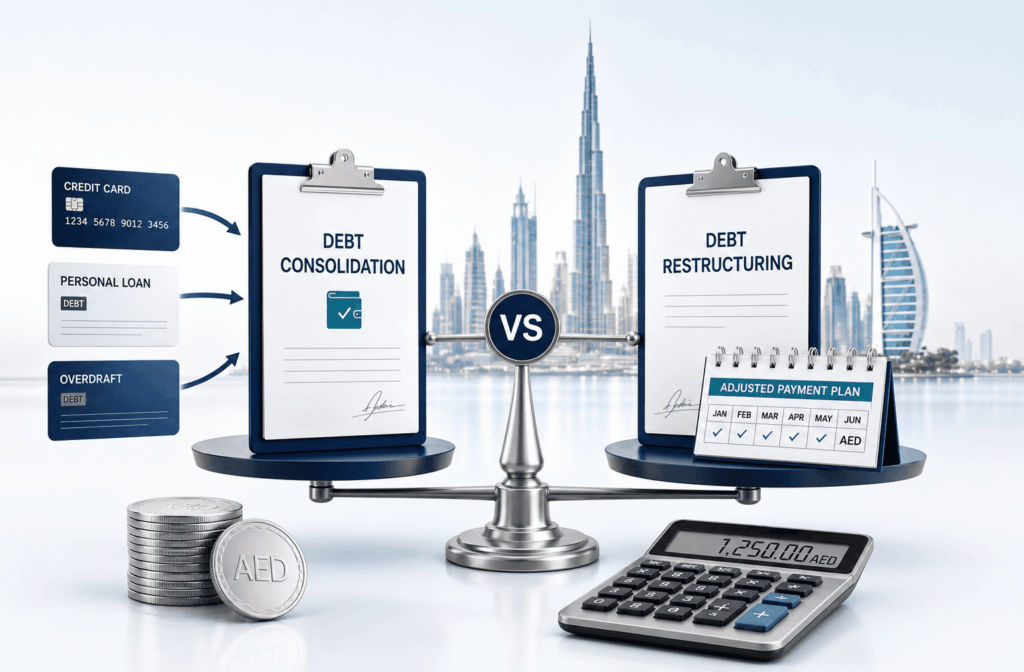
The difficulty with debt consolidation is that it usually requires another lender to approve new finance. If payments have already been missed or existing commitments are very high, that option may become harder to obtain. In that situation, discussing debt restructuring or revised repayment arrangements with existing creditors may be more realistic than repeatedly applying for another loan.What Can Weaken Your Credit Position?
Credit problems rarely appear all at once. They often build gradually over several months as balances increase, payments become harder to manage or new borrowing is used to cover existing commitments.- late or missed loan instalments;
- large revolving credit card balances;
- regularly using most of the available card limit;
- several new credit applications in a short period;
- forgotten or unsettled obligations; and
- incorrect or outdated information appearing on the credit report.
How to Improve Your Credit Position
- Start with your credit report. Before trying to improve the score, check whether the accounts, balances and facilities shown are actually correct.
- Protect your repayment history. Even a payment missed because there was not enough money in the account can create an avoidable problem.
- Reduce high card balances. Lower revolving debt can improve both your overall liability position and monthly affordability.
- Avoid applying everywhere at once. If several banks have already declined an application, it is usually more useful to understand why before submitting another one.
- Keep settlement documents. No Liability Certificates, settlement letters and account-closure documents can be important if you later need to query a facility.
A Practical Point From Lotus Debt Management
After a bank rejection, one of the first questions borrowers ask is: “How can I increase my AECB score?” Sometimes that is the wrong question. A more useful starting point is: why did the borrowing request become difficult? The problem may involve repayment history, but it could just as easily be a high DBR, several active credit cards, large outstanding balances or limited disposable income. In some cases, the borrower is simply asking for more finance than the current income can comfortably support. Looking at the full liability position usually tells you more than focusing on one three-digit number.For current official information, refer to:
Bank lending criteria vary between institutions and can change over time. Regulatory limits should not be interpreted as guaranteed borrowing eligibility.
Frequently Asked Questions (FAQs)
Does a low credit score mean I cannot get a loan in the UAE?
Not necessarily. While a lower credit score may reduce your borrowing options or result in higher interest rates, lenders also consider factors such as your income, employment stability, existing liabilities, and Debt Burden Ratio (DBR).
How long does it take for a cleared loan to reflect on the AECB report?
Updates may not appear immediately after a facility is settled. If the account still appears incorrectly, contact the lender and AECB to clarify the record.
Can my credit score affect my interest rate?
Yes. Borrowers with stronger credit profiles are often offered more competitive interest rates and better repayment terms, while lower scores may result in higher borrowing costs.
Does checking my own AECB credit report lower my score?
No. Checking your own credit report through the AECB mobile application or website is registered as a “soft inquiry” and has zero negative effect on your credit score.
Can Lotus Debt Management help if my credit score is already affecting my finances?
Yes. Lotus Debt Management helps clients review their overall financial situation, understand their credit profile, assess suitable borrowing or debt management options, and explore solutions such as debt consolidation or debt restructuring where appropriate.