
Managing debt can quickly become overwhelming, especially when you are trying to juggle multiple personal loans, maxed-out credit cards, and overlapping monthly deadlines. If you are actively looking for a lifeline to regain control of your finances in the UAE, you have likely come across two popular solutions: Debt Consolidation and Debt Restructuring.
While people often use these terms interchangeably, they are completely different financial strategies. Each is designed for a very specific type of financial situation. Understanding how they work is the first step to avoiding unnecessary stress and making a choice that protects your financial future.
At Lotus Debt Management, we help individuals across the UAE cut through the confusion. Here is exactly how these two solutions differ, and how to know which one is right for you.
What Is Debt Consolidation?
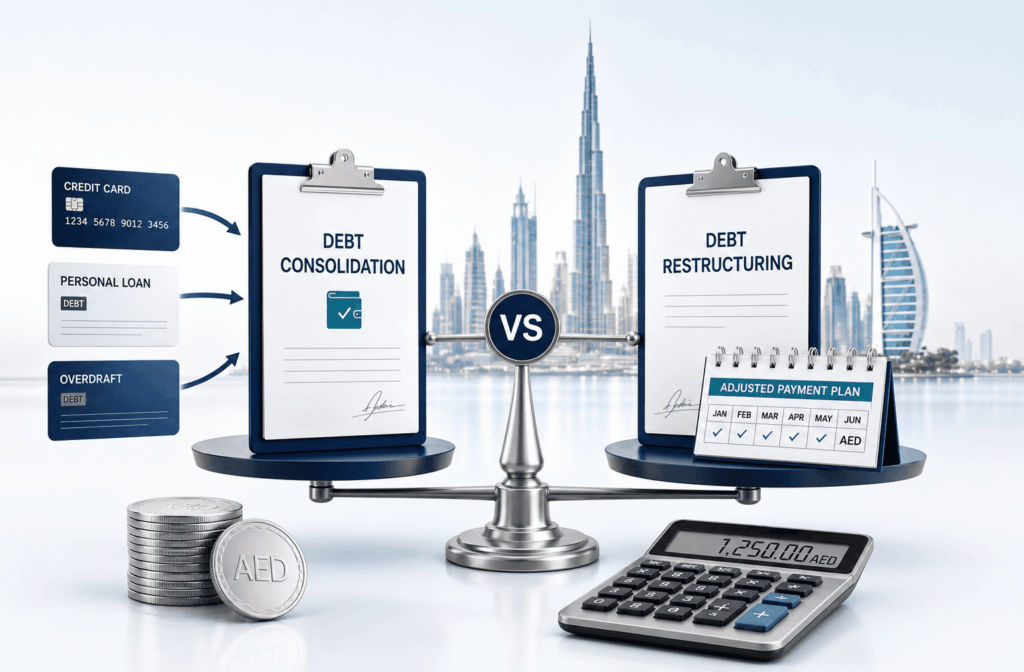
Think of Debt Consolidation as a financial reset button. It is the process of combining multiple existing debts into one brand-new loan with a single monthly repayment.
Instead of logging into different banking apps to pay off various credit cards and personal loans at different interest rates throughout the month, a consolidation loan pays off all those individual lenders. You are left with one clear, manageable Equated Monthly Installment (EMI).
The primary goal: Simplify your financial life while potentially lowering your overall borrowing costs.
The Benefits of Debt Consolidation
- One Simple Payment: A single due date replaces multiple confusing deadlines.
- Lower Interest Rates: Often significantly cheaper than high-interest credit card rates.
- Better Cash Flow: A longer repayment term can reduce your overall monthly EMI.
- Zero Missed Payments: It is much easier to budget for one automated deduction.
- Clear Timeline: You get a structured, predictable path to becoming debt-free.
What Is Debt Restructuring?
Debt Restructuring is a specialized solution designed for borrowers who have hit a wall. If you are experiencing genuine financial hardship—such as a job loss, salary reduction, or medical emergency—and simply cannot afford your current payments, restructuring is your safety net.
Unlike consolidation, you do not take out a new loan. Instead, debt restructuring involves actively negotiating with your current bank (or banks) to modify the terms of the money you already owe.
Depending on your financial reality, a debt restructuring plan might include:
- Significantly lowering your monthly installments.
- Extending the total lifespan of the loan.
- Freezing or reducing aggressive interest rates.
- Securing a temporary payment holiday to help you get back on your feet.
The primary goal: Stop the financial bleeding, prevent legal action, and create a survival plan that respects your current income.
The Key Differences at a Glance
Choosing the wrong solution can actually make your financial situation worse. Here is a clear breakdown of how they compare:
| Feature | Debt Consolidation | Debt Restructuring |
|---|---|---|
| The Core Action | Combines multiple debts into one new loan. | Modifies the rules of your existing loans. |
| Who It Is For | Borrowers managing well, but wanting simplicity. | Borrowers facing severe financial hardship. |
| The Monthly EMI | One single, consolidated payment to a new lender. | Existing EMIs are adjusted downward. |
| Interest Rates | Usually secured at a lower, blended rate. | Renegotiated directly with your current bank. |
| Payment Status | Best if you are currently paying on time. | Best if you are falling behind or expect to soon. |
| AECB Credit Score | Requires a healthy AECB score (typically 541+). | Score is largely irrelevant; hardship is the focus. |
Which Option Is Right for You?
Rather than guessing, you need to look at your current Debt Burden Ratio (DBR) and cash flow.
Debt Consolidation is likely your best move if:
- You have multiple loans and cards, but a stable income.
- You have a clean track record of paying on time.
- You have a strong Al Etihad Credit Bureau (AECB) score.
- You just want to stop paying high credit card profit rates and simplify your life.
Debt Restructuring is your best lifeline if:
- You are already missing payments (or know you will next month).
- Your monthly income has suddenly dropped.
- Late fees and penalty interest are artificially inflating your balances.
- You need immediate, urgent relief to avoid bank harassment or legal trouble.
Common Myths About Debt Management
- Myth 1: Consolidation makes your debt disappear.
Reality: It does not erase what you owe; it reorganizes it so you can pay it off faster and cheaper. - Myth 2: Restructuring means you have failed.
Reality: Life happens. Job markets shift, and emergencies cost money. Restructuring is a smart, legal, and bank-approved way to hit pause and recover. - Myth 3: Anyone can get a consolidation loan.
Reality: Banks still run strict checks. If your AECB score has already dropped from missed payments, consolidation might no longer be an option.
Why Professional Debt Advice Matters
Many borrowers try to negotiate with banks on their own, only to be rejected because they used the wrong terminology or couldn’t prove their financial hardship correctly.
At Lotus Debt Management, we bring decades of banking experience to your side of the table. We don’t just hand you a generic brochure; we conduct a comprehensive financial assessment to map out your income, liabilities, and exact Debt Burden Ratio.
Whether we are guiding you toward a smart consolidation loan or fighting on your behalf to force the banks to restructure your terms, our goal is to protect you.
Avoid These Costly Mistakes
- Waiting until your credit cards are blocked to ask for help.
- Using one credit card to pay the minimum balance on another.
- Accepting a bank’s “quick fix” without calculating the long-term interest costs.
- Trying to navigate aggressive bank collection calls without professional backup.
💡 Ready to explore your options? The most effective financial solution is the one built specifically for your life. You do not have to figure this out alone. Contact us today for a confidential review.
Frequently Asked Questions (FAQs)
What is the main difference between debt consolidation and debt restructuring?
Will debt consolidation actually reduce my monthly EMI?
Is debt restructuring only for people who have already defaulted?
No. In fact, approaching your bank before you default is highly recommended. Proving that you are facing an upcoming financial hardship gives you much more negotiating power than waiting until your accounts are frozen.
Can I consolidate both personal loans and credit card debt together?
Yes. Subject to your AECB score and bank approval, you can combine multiple unsecured debts—including personal loans and credit card balances—into one clean payment.
How can Lotus Debt Management help me choose?
We run a full diagnostic on your finances. By analyzing your AECB report, income, and DBR, we can definitively tell you which banks will approve a consolidation loan, or if we need to immediately deploy a restructuring strategy to protect your cash flow.
How can Lotus Debt Management help me choose?
We run a full diagnostic on your finances. By analyzing your AECB report, income, and DBR, we can definitively tell you which banks will approve a consolidation loan, or if we need to immediately deploy a restructuring strategy to protect your cash flow.
When should I seek professional debt advice?
The moment you start relying on minimum credit card payments to survive, or you feel anxiety about your upcoming due dates. Early intervention gives you options; waiting limits them.